
Serving tech employees in Palo Alto, Mountain View, Sunnyvale, San Jose, Cupertino, Fremont, Newark, Pleasanton, Dublin, San Ramon, Danville, and throughout the Silicon Valley and East Bay/Tri-Valley corridor.
If you’re a software engineer going through a divorce in Silicon Valley or the East Bay, your compensation package is probably more complicated than a simple salary — and that complexity follows you straight into family court. Restricted stock units (RSUs), stock options, sign-on bonuses, and refresh grants are often the single largest asset in a tech employee’s marital estate, sometimes worth far more than a house. Dividing that equity correctly requires understanding not just family law, but how equity compensation actually works at companies like Google, Apple, Meta, Nvidia, Cisco, and the many venture-backed startups throughout the Bay Area.
This page explains how California courts characterize and divide RSUs and stock options in divorce, with a focus on the issue that trips up most engineers and even many attorneys: how the timing of when equity is granted and when it vests determines whether it belongs to you, your spouse, or the marital community.
Why Software Engineer Divorces Are Different
Tech compensation at Silicon Valley and East Bay companies typically includes several features that create unique issues in a divorce:
- Multi-year vesting schedules. RSU grants commonly vest over four years, often with a one-year cliff, meaning shares granted before a marriage can still be vesting well into the marriage — or vice versa.
- Multiple overlapping grants. Engineers who’ve been promoted, received refresh grants, or changed employers may be holding several grants at once, each with its own grant date and vesting schedule.
- Mixed equity types. RSUs, incentive stock options (ISOs), and non-qualified stock options (NSOs) are taxed differently and require different valuation approaches.
- Private company and startup equity. Pre-IPO equity has no public market price, and its value depends on 409A valuations, liquidation preferences, and the uncertain timing of an IPO or acquisition.
- High dollar values. A single grant at a large public tech company can be worth more than most other assets in the marriage combined, so getting the characterization and valuation right has an outsized financial impact.
How California Characterizes RSUs and Stock Options
California is a community property state. Under Family Code section 760, property acquired during the marriage is presumed to belong equally to both spouses. Under Family Code sections 770 and 771, property acquired before marriage or after the date of separation is that spouse’s separate property.
Equity compensation doesn’t fit neatly into either category, because a grant is usually awarded on one date but earned (vested) over several years that may span periods of single life, marriage, and separation. California courts resolve this with an apportionment approach: they look at what the grant was intended to compensate — past service, or future service — and divide the shares proportionally between community and separate property using a “time rule.”
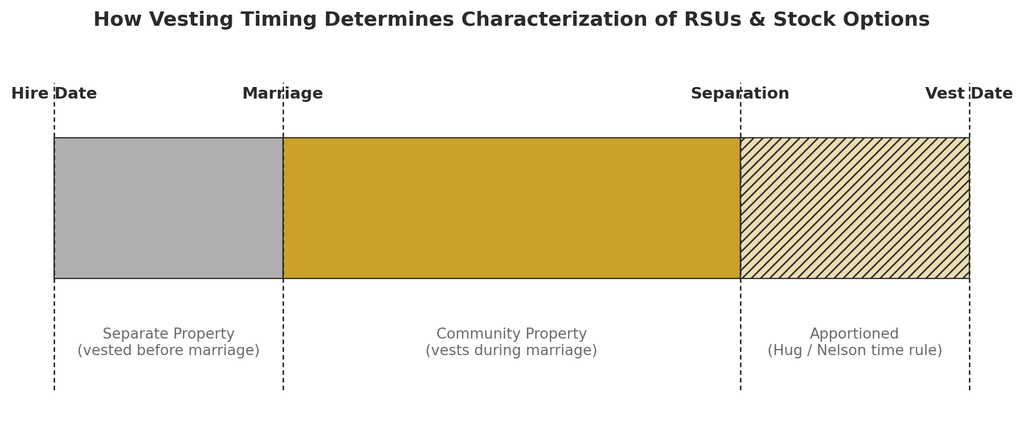
Characterization by Timing: Before Marriage, During Marriage, and After Separation
This is the question we’re asked most often, and the answer depends on exactly when the equity vested relative to the marriage and the date of separation.
RSUs and Options That Vest Before Marriage
Equity that is granted and fully vests before the date of marriage is the separate property of the employee spouse. It was earned entirely through pre-marital service and never became part of the community estate, even if the shares are sold or the proceeds are later commingled (commingling can create its own tracing issues, but the underlying equity itself is separate property).
RSUs and Options That Vest During the Marriage
Shares that vest while the couple is married and living together are community property and are generally divided equally, regardless of when the grant was originally awarded. This is true even if the underlying grant was made before the marriage began — what matters for this category is that the vesting (the moment the employee actually earns the shares) happened during the marriage.
RSUs and Options Granted During Marriage but Unvested at Separation
This is the category that requires a formula. When a grant was awarded during the marriage but some or all of the shares are still unvested on the date of separation, California courts apportion the shares between community and separate property using one of two time-rule formulas from published appellate decisions:
The Hug Formula — In re Marriage of Hug (1984) 154 Cal.App.3d 780
- Used when the grant was primarily intended to reward past or existing service (e.g., a retention or compensation-replacement grant).
- Community share = (months from date of hire to date of separation) ÷ (months from date of hire to date the shares vest) × number of shares.
- Because it measures from the hire date, the Hug formula tends to allocate a larger share to the community.
The Nelson Formula — In re Marriage of Nelson (1986) 177 Cal.App.3d 150
- Used when the grant was primarily intended as an incentive for future service (e.g., a forward-looking refresh or promotion grant).
- Community share = (months from date of grant to date of separation) ÷ (months from date of grant to date the shares vest) × number of shares.
- Because it measures from the grant date rather than the hire date, the Nelson formula typically allocates a smaller share to the community.
Worked example (Nelson formula): Suppose an engineer received a refresh grant of 4,800 RSUs on January 1, 2024, vesting over 4 years (48 months). The couple separates on January 1, 2026 (24 months after grant) and the tranche in question vests on January 1, 2028 (48 months after grant). The community share of that tranche would be 24 ÷ 48 × 4,800 = 2,400 shares community property, with the remaining 2,400 shares as the employee spouse’s separate property.
As the Hug court itself cautioned, “no single rule or formula is applicable to every dissolution case involving employee stock options” — trial courts retain broad discretion to select the formula, or a variation of it, that best fits the facts of a particular grant. Which formula applies (and how a court interprets the purpose of a particular grant) is often the most heavily contested valuation issue in a tech divorce, and is exactly the kind of issue where experienced counsel and, often, a forensic accountant make a real difference.
RSUs and Options Granted After the Date of Separation
Equity granted entirely after the date of separation — for example, a new-hire grant from a job started post-separation, or an annual refresh awarded after separation — is the separate property of the employee spouse. The community’s interest in a spouse’s earning capacity ends at separation, so grants made afterward reflect only that spouse’s own post-separation efforts.
Quick-Reference Summary
- Vests before marriage → Separate property of employee spouse
- Vests during marriage → Community property, divided equally
- Granted during marriage, unvested at separation → Apportioned by time rule (Hug or Nelson formula)
- Granted after date of separation → Separate property of employee spouse
Other Equity & Tax Issues Unique to Tech Employees
ISOs, NSOs, and RSUs Are Taxed Differently
- RSUs: taxed as ordinary income on the value at vesting date under Internal Revenue Code section 83, with payroll withholding taken at vest.
- Non-qualified stock options (NSOs): taxed as ordinary income on the spread between exercise price and fair market value, at the time of exercise.
- Incentive stock options (ISOs): can qualify for favorable capital-gains treatment if holding-period rules are met, but often trigger alternative minimum tax (AMT) exposure at exercise.
These tax differences affect the real, after-tax value of each spouse’s share, and should be factored into any settlement or buyout — dividing gross shares equally is not the same as dividing equal after-tax value.
Private Company and Startup Equity
Engineers at pre-IPO startups face an added layer of complexity: there’s no public market price, so shares are valued using 409A valuations, recent funding-round pricing, or expert appraisal. Liquidity is also uncertain — a court may need to order a deferred distribution because there is simply no way to cash out shares until an IPO, acquisition, or company-sponsored tender offer occurs.
Deferred (“If and When Vests”) Distribution Orders
For unvested equity, California courts frequently defer division rather than forcing an immediate buyout: the court fixes the community’s percentage interest now, and orders that the non-employee spouse receive their share of the shares (or their cash equivalent) if and when they actually vest. This avoids forcing a valuation of stock that hasn’t been earned yet, but requires careful drafting so the order survives job changes, stock splits, and company acquisitions.
The “Double-Dipping” Problem
A frequently litigated issue is whether the same equity can be counted twice: once as a divided community asset, and again as income for calculating spousal or child support. Courts differ on how to handle RSU income that vests post-separation, especially where the grant itself was already characterized as community property. This is an issue every engineer going through a divorce should raise with their attorney early, since it can significantly change the numbers on both sides of the ledger.
What to Gather When Preparing for Divorce
Because so much turns on grant dates, vesting schedules, and the purpose of each grant, we typically request:
- Complete equity grant history from your stock plan administrator (e.g., Fidelity, Schwab, Shareworks, Carta)
- Offer letters and promotion/refresh letters describing the purpose of each grant
- Vesting schedules and vesting confirmation statements
- 409A valuations, if you hold private company equity
- W-2s and pay stubs showing RSU income already recognized
- All documentation of any stock sales, including brokerage trade confirmations, 1099-B forms, and any sale notices from your employer or stock plan administrator (e.g., E*TRADE, Fidelity, Shareworks).
- Bank statements showing the deposit of stock sale proceeds. Start gathering these now — most banks only keep statements accessible online for about 5 to 7 years (the Bank Secrecy Act sets a 5-year federal floor, and many banks purge or archive records beyond 7–10 years), so records of older stock sales can become difficult or impossible to obtain once that window closes. Download and save PDF copies yourself rather than relying on being able to request them from the bank later.
If you haven’t married yet, a well-drafted prenuptial agreement can address in advance how future RSU grants, stock options, and other equity compensation will be treated if the marriage ends — while still leaving your spouse comfortably provided for. See our guide, “Do You Need a Prenup?”, for more on how this works.
Talk to a Silicon Valley & East Bay Family Law Attorney
Mock Law regularly handles divorces involving RSUs, stock options, ESPPs, and startup equity for engineers and other tech professionals throughout Palo Alto, Mountain View, Sunnyvale, San Jose, Cupertino, Fremont, Newark, Pleasanton, Dublin, San Ramon, and Danville. Whether your equity is fully vested, still on a vesting schedule, or tied up in a private company you can’t yet cash out of, we can help you understand what’s really at stake and negotiate — or litigate — a fair division.
Call (415) 523-7969 for a consultation, or reach out through our website to discuss your equity compensation and divorce.
This page is provided for general informational purposes only and does not constitute legal advice. Every case is different — please consult with an attorney about the specific facts of your situation.