
Serving tech executives, founders, VCs, and other high-income professionals in Palo Alto, Menlo Park, Atherton, Los Altos, San Jose, San Francisco, Fremont, Pleasanton, Danville, and throughout Silicon Valley and the East Bay.
If you or your co-parent earns a very high income — whether from a tech executive salary, equity compensation, a startup exit, venture returns, or a professional practice — divorce raises a question that catches many high earners off guard: how much child support can actually be ordered when income is well above what the state’s guideline calculators were built to handle?
The short answer is that California law does not impose a hard dollar ceiling on child support, and the underlying philosophy is that children are entitled to share in the standard of living made possible by both parents’ incomes — no matter how high those incomes are. This page explains how that plays out in practice, why a prior support order is never truly “final,” and why a rising bonus doesn’t increase support proportionally the way many high earners expect.
How Child Support Is Actually Calculated
California child support is not a judgment call — it starts from a statutory guideline formula set out in Family Code section 4055:
The Guideline Formula — Family Code § 4055
- CS = K[HN – (H%)(TN)]
- CS: the child support amount.
- HN: the higher earner’s net disposable monthly income.
- H%: the approximate percentage of time the higher earner spends with the children.
- TN: the parents’ combined net disposable monthly income.
- K: a formula-derived factor reflecting both parents’ combined ability to pay.
In practice, attorneys and courts run this formula through certified software — most commonly Xspouse or DissoMaster — rather than calculating it by hand. Family Code section 4053 sets out the policy principles behind the formula, including that “a parent’s first and principal obligation is to support his or her minor children according to the parent’s circumstances and station in life,” and that children are entitled to share in each parent’s standard of living. The guideline amount is presumed to be the correct amount of child support in every case, including high-income cases.
Why a “Final” Order Is Never Really Final
One of the most common misconceptions high-earning parents have is that once a child support order is entered — especially if the judgment recites that the amount “adequately meets the needs of the child” — that number is locked in. It isn’t.
- Child support can always be modified. Family Code section 3651(a) allows a support order to be modified or terminated “at any time as the court determines to be necessary,” and California courts retain continuing jurisdiction over child support until each child turns 18 (or 19, if still a full-time high school student and unmarried).
- This cannot be waived by agreement. Unlike spousal support, which divorcing spouses can agree in writing to make non-modifiable, parents cannot bargain away a child’s right to future modification. The court’s jurisdiction to revisit child support belongs to the child, not the parents, and no settlement language can override it.
- Modification requires a change in circumstances. A parent seeking to modify support generally must show a material change since the last order — commonly a significant increase or decrease in income, a change in custodial time, or a change in the children’s needs.
- Modifications are prospective, not retroactive. Under section 3651(c), a modified amount generally applies only from the date the request for modification (Judicial Council form FL-300) is filed — not from whenever the underlying change in circumstances actually happened. This is why parents whose income changes should file promptly rather than wait.
So even if a prior judgment or order specifically and expressly states that the amount set at that time is sufficient to meet the reasonable needs of the child, that language does not, and legally cannot, act as a bar to a court modifying — and increasing — child support in the future if either parent’s income or the children’s circumstances later change.
There Is No Real Cap on Child Support
California’s guideline formula has no built-in dollar ceiling — it simply keeps producing a larger number as income rises. Courts have repeatedly confirmed that extraordinarily high incomes don’t exempt a parent from the formula, and that a child of a wealthy parent is entitled to a standard of living consistent with that wealth:
- McGinley v. Herman (1996) 50 Cal.App.4th 936 — held that a child is entitled to share in the standard of living of an extraordinarily high-earning parent, not merely to have his or her basic needs met.
- In re Marriage of Hubner (2001) 94 Cal.App.4th 175 — confirmed that a child’s “needs” are measured by the standard of living the high-earning parent’s income makes attainable, not by the family’s historical spending habits.
- In re Marriage of Cheriton (2001) 92 Cal.App.4th 269 — a Silicon Valley case frequently cited for the principle that a child is entitled to a share of a high-earning parent’s wealth, not just a subsistence-level amount.
There is one narrow safety valve: under Family Code section 4057(b)(3), a paying parent whose income is “extraordinarily high” can ask the court to order less than the guideline amount — but only if that parent proves the guideline figure actually exceeds the children’s reasonable needs. The burden of proof is on the high earner, courts apply this exception sparingly, and simply being wealthy is not enough to win a reduction (see In re Marriage of Stephenson (1995) 39 Cal.App.4th 71, addressing the burden on a parent seeking a downward modification). In one closely watched case, In re Marriage of Macilwaine (2018) 26 Cal.App.5th 514, an appellate court upheld a trial court’s decision to cap guideline income at a set level with true-up provisions for actual earnings above it — but only after the kind of detailed evidentiary showing most high earners will not be able to make. The exception proves the rule: absent that showing, the formula applies in full, however large the number gets.
The catch for high earners is that California law doesn’t clearly define what a child’s “reasonable needs” actually are once a family’s income reaches this level — and that ambiguity tends to cut against, not for, the paying parent. Most people would say a child doesn’t reasonably “need” to fly by private jet to a summer vacation. But if the high-earning parent regularly travels that way, a court may well conclude that the child’s standard of living — the actual legal standard — includes flying privately too, since the child is entitled to share in the parent’s lifestyle, not just have a checklist of necessities covered. In other words, “reasonable needs” in an extraordinarily high-income household is measured against how that family actually lives, not against a generic or minimal standard, which makes the section 4057(b)(3) exception even harder for a high earner to win in practice.
High-Profile Examples in the News
California’s approach to high-income support has played out publicly in several widely reported cases. These figures come from news reporting on settlements and court filings, not from court opinions we have independently verified, so they should be read as illustrations of the pattern rather than as citable legal authority:
- Kevin Costner / Christine Baumgartner (Santa Barbara County, 2023) — a temporary order set Costner’s child support at $129,755 per month for three children, reportedly about half of the $217,300 monthly guideline figure calculated from his reported net disposable income of roughly $7.6 million per year; the case later settled at $63,209 per month.
- Kanye “Ye” West / Kim Kardashian (Los Angeles County) — West was reportedly ordered to pay $200,000 per month in child support for the couple’s four children.
- Sia / Dan Bernad (Los Angeles County, 2024) — reported settlement terms include $42,500 per month in child support for one child, plus private school tuition and a $5 million life insurance policy naming the child as beneficiary.
None of these amounts reflect a legal maximum — they reflect what the guideline formula (or a negotiated settlement in its shadow) produced given each parent’s actual income. A tech executive, founder, or partner with comparable income in the Bay Area would be subject to the exact same formula and the exact same “no real cap” principle.
The Bonus Income Puzzle: Why Support Doesn’t Scale the Way You’d Expect
Here is the part that surprises many high earners: because the section 4055 formula is not a flat percentage of income, the share of each additional dollar that goes to support actually shrinks as income climbs. A parent whose compensation is heavily weighted toward an annual bonus, RSU vesting, or a carry distribution will often see their support obligation grow far less than proportionally when that variable income spikes — the opposite of what a linear, salary-based estimate would suggest.
This is precisely why family law practitioners handle bonus and other lump-sum variable income differently from base salary, using what’s known as a Smith/Ostler order:
The Smith/Ostler Approach — In re Marriage of Ostler & Smith (1990) 223 Cal.App.3d 33
- Rather than folding a large, unpredictable bonus into the ongoing guideline calculation, the court sets a base support figure on fixed salary alone.
- The payor then owes an additional percentage of any bonus or other variable income actually received, paid when it’s received.
- Because the guideline formula’s marginal allocation declines at higher income levels, that additional percentage is typically tiered downward — higher on the first slice of bonus income, lower on the next slice, and lower still above that.
An illustrative (not universal) tiered structure looks like this:
- $0 – $250,000 of bonus: roughly 20% marginal support
- $250,000 – $750,000 of bonus: roughly 15% marginal support
- $750,000 – $1,500,000 of bonus: roughly 10% marginal support
- Above $1,500,000 of bonus: roughly 0% marginal support
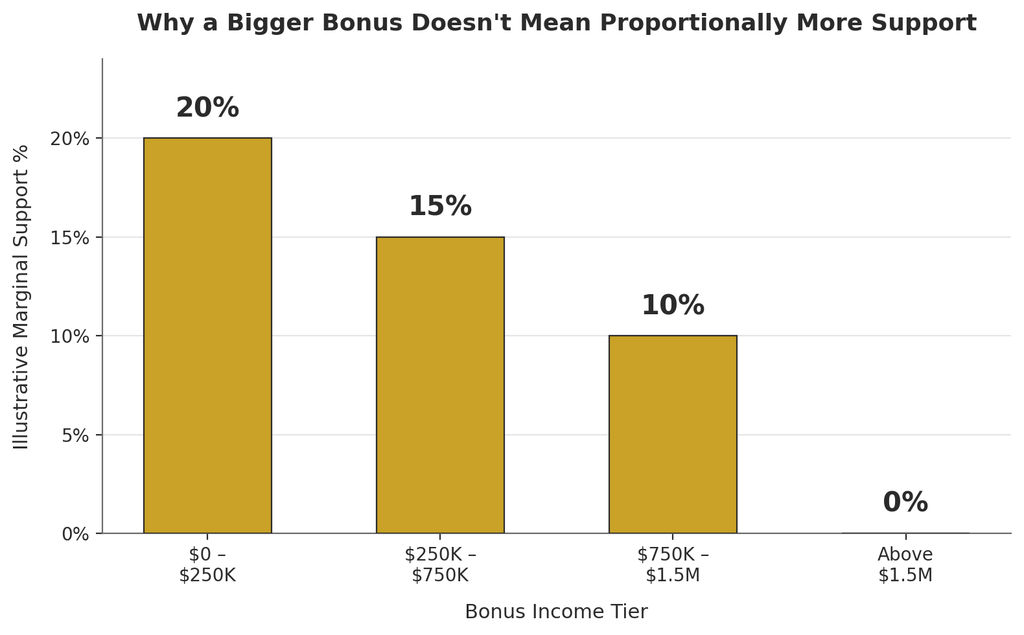
In this kind of structure, a $1.4 million bonus year might generate roughly $190,000 in additional support — an effective rate of well under 15%, even though the base guideline percentage on ordinary salary income would be considerably higher. The irony high earners often notice is real: the bigger the bonus, the smaller the marginal share of it that goes to support, precisely because the guideline formula was designed to avoid runaway support figures on runaway income, while still ensuring the children benefit from every dollar the parent actually earns.
What Bay Area High Earners Should Do
- Don’t assume a past order is locked in. If your income (or your co-parent’s) has materially changed since the last order, a modification request may be appropriate — in either direction.
- Get equity and variable compensation properly characterized. RSUs, stock options, carried interest, and bonus structures all require careful income characterization; treating them incorrectly can distort support calculations substantially.
- Expect the guideline formula to control. Arguing for a reduction based on “extraordinarily high income” under section 4057(b)(3) is possible but requires a strong evidentiary showing — it is the exception, not the default outcome.
- Consider a Smith/Ostler structure for bonus income. Rather than disputing a single guideline number built on an assumed bonus, a tiered bonus percentage tied to actual, received income is often fairer and more predictable for both sides.
- File promptly when circumstances change. Because modifications are generally prospective only from the filing date, delay can be costly.
- Be mindful of who hears about a new job, promotion, or company you’ve founded. A higher base salary or bonus opportunity is good news, but it isn’t necessarily news to broadcast widely — and it’s generally not something to volunteer to your co-parent directly. A material increase in income is exactly the kind of change in circumstances that can prompt the other parent to file for a child support modification seeking more support. This isn’t a suggestion to conceal income that must be properly and honestly disclosed if a modification request is actually filed — but there’s no obligation to advertise a raise, a new job, or a new venture before that happens.
Talk to a Silicon Valley Family Law Attorney
High-income child support cases involve significant money, complex compensation structures, and legal standards that don’t work like ordinary guideline cases. Mock Law represents high-earning parents and their co-parents throughout Silicon Valley and the East Bay in child support matters, from guideline calculations to extraordinarily-high-income disputes. Call (415) 523-7969 to schedule a consultation.
This page is for general informational purposes only and does not constitute legal advice. Every case is different — please consult a qualified family law attorney about your specific situation.