
Serving business owners in Palo Alto, Mountain View, Sunnyvale, San Jose, Cupertino, Fremont, Newark, Pleasanton, Dublin, San Ramon, Danville, and throughout the Silicon Valley and East Bay/Tri-Valley corridor.
If you own a business and you’re facing divorce, the business itself is often the single most valuable — and most contested — asset in the case. Whether it’s a restaurant, a consulting practice, a medical or dental office, a construction company, or a company you built from nothing, California law treats a business interest built during marriage as community property, and dividing it correctly requires getting the valuation right before anything else can be resolved.
This page walks through how California characterizes and values a business in divorce, the two competing legal formulas courts use when a business existed before the marriage but grew during it, and the practical steps every business-owning spouse should take to protect the company and get a fair outcome.
Why Business Owner Divorces Are Different
- The business is usually the largest asset. For many owner-operators, the business is worth more than the house, retirement accounts, and everything else in the marriage combined.
- There’s no public market price. Unlike a stock portfolio, a privately held business has to be valued by an expert — and the valuation methodology chosen can swing the number by hundreds of thousands of dollars or more.
- Ownership can’t always be split. Courts generally can’t force ex-spouses to co-own and run a business together, so the usual outcome is a buyout: one spouse keeps the business and the other receives an equalizing payment of other assets.
- Personal and business finances often overlap. Owner compensation, perks run through the business (vehicles, travel, phones), and retained earnings all affect both the valuation and support calculations.
- Timing matters enormously. Whether the business existed before the marriage, was founded during it, or grew substantially after separation changes which formula applies to divide it.
How California Characterizes a Business in Divorce
Under Family Code section 760, a business founded and built during the marriage using community time, money, or effort is presumptively community property, and both spouses are generally entitled to an equal share of its value. Under Family Code section 770, a business owned before the marriage is the separate property of the owner spouse — but that doesn’t end the analysis.
The harder case, and the one that drives most litigation, is a business that already existed before the marriage but increased in value while the couple was married. California courts apportion that growth between separate and community property using one of two formulas, depending on what caused the business to grow.
The Pereira Approach — Pereira v. Pereira (1909) 156 Cal. 1
- Used when the business grew mainly because of the owner-spouse’s personal effort and labor during the marriage.
- The owner-spouse keeps their original separate-property investment plus a fair rate of return on it (courts often use a modest, “well secured” interest rate).
- Everything above that fair return is community property.
- Because it caps the separate-property return at a modest rate, Pereira tends to allocate more of the growth to the community — it favors the non-owner spouse.
The Van Camp Approach — Van Camp v. Van Camp (1921) 53 Cal.App. 17
- Used when the business grew mainly because of market forces, capital, brand, or other factors not primarily tied to the owner-spouse’s personal labor.
- The community is credited with a reasonable salary for the owner-spouse’s work during the marriage (minus community living expenses already covered by that salary).
- All remaining appreciation in the business stays the owner-spouse’s separate property.
- Because it only credits the community with a salary rather than a share of the growth itself, Van Camp tends to favor the owner-spouse.
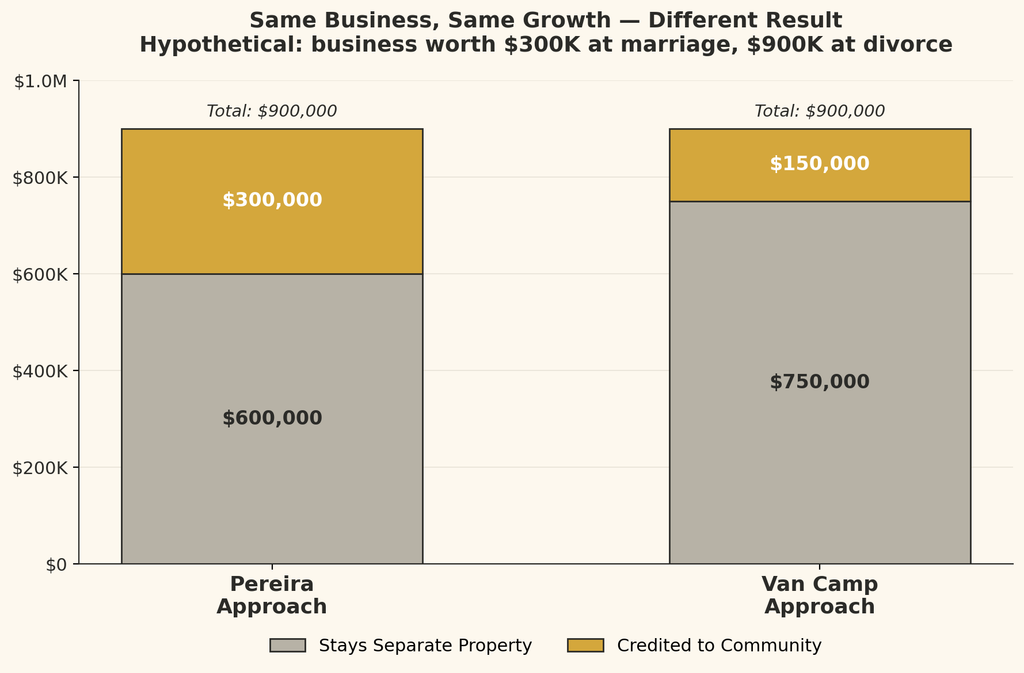
Courts have broad discretion to choose whichever approach — or a blend — best fits the facts, and which formula applies is frequently the most heavily litigated issue in a business-owner divorce. This is exactly the kind of determination where a forensic accountant and experienced family law counsel make a measurable financial difference.
How the Business Gets Valued
Once it’s established what portion of the business is community property, the business itself has to be valued. California Family Code section 2552 generally requires valuation as close to the trial date as practicable, though the court can set an earlier date for good cause. Appraisers typically rely on one or more of three approaches:
- Income approach. Values the business based on its ability to generate future earnings, using capitalization of earnings or a discounted cash flow analysis. Common for consulting firms, professional practices, and service businesses with stable earnings.
- Market approach. Compares the business to recent sales of similar businesses. Works well for restaurants, franchises, medical/dental practices, and other businesses with an active resale market.
- Asset approach. Totals the fair market value of the business’s tangible and intangible assets minus its liabilities. Best suited to asset-heavy businesses like real estate holding companies or equipment-heavy operations.
Appraisers also normalize the business’s financials — resetting owner compensation to a market salary, removing personal expenses run through the business, and stripping out one-time or non-recurring items — before applying any of these methods.
A Forensic Accountant Is Not Optional
Business valuation in a California divorce is not something spouses, or even their attorneys, can credibly do on their own. In virtually every case involving a business of any real size, a qualified forensic accountant or certified business valuation expert is required to produce a valuation the court will accept — courts routinely reject informal estimates, back-of-envelope multiples, or one spouse’s opinion of what the business is “probably worth.”
These experts are expensive — a full valuation commonly runs into the thousands to tens of thousands of dollars depending on the size and complexity of the business, and each side may need its own expert if the parties don’t agree to share a single neutral evaluator. That cost is real, but it is not avoidable: judges expect a properly credentialed valuation before they will divide a business interest, and skipping this step (or relying on a spouse’s guess) is one of the most common and costly mistakes business owners make in divorce. Budget for this expense early, and talk to your attorney about whether a jointly retained neutral expert (which can reduce total cost) makes sense for your case.
Goodwill: The Most Contested Number in the Case
Beyond hard assets, a profitable business often has goodwill — the value of its reputation, customer relationships, and expectation of continued business. California treats goodwill built during the marriage as a divisible community asset (Golden v. Golden (1969); In re Marriage of Foster (1974) 42 Cal.App.3d 577). Goodwill is commonly valued using the “excess earnings” method: the appraiser subtracts a reasonable market salary for the owner’s work from the business’s actual earnings, and capitalizes the remaining “excess” into a goodwill figure.
One critical limit: goodwill cannot be valued using any method that depends on the owner-spouse’s efforts after the date of separation, since post-separation earnings are that spouse’s separate property. Distinguishing goodwill tied to the business itself from goodwill tied to the owner’s personal future labor is often the central battleground in the valuation fight.
What Happens to the Business After Divorce
Courts generally don’t force former spouses to remain business partners. The typical outcome is that the operating spouse keeps the business, and the other spouse receives an “equalizing payment” — other marital assets (or a structured payout over time) equal to half the community value of the business. If both spouses genuinely co-run the business and want to continue, a negotiated buy-sell or continued co-ownership arrangement is possible, but it requires both spouses’ agreement and carries its own risks.
Watch Out for “Double-Dipping”
A frequently disputed issue is whether the same business income gets counted twice: once when the business is valued and divided as an asset, and again when that same income stream is used to calculate spousal or child support. Ask your attorney how the numbers being used for valuation relate to the numbers being used for support — these should be reconciled, not simply added together.
What to Gather When Preparing for Divorce
Because the valuation depends heavily on complete financial records, we typically request:
- 3 to 5 years of business tax returns and financial statements (profit & loss, balance sheets)
- Corporate formation documents, operating/shareholder/partnership agreements, and any buy-sell agreements
- Bank statements and QuickBooks (or other accounting software) records for the business
- Accounts receivable, work-in-progress, and inventory records
- Documentation of any personal expenses paid through the business (vehicles, travel, phones, family members on payroll)
- Records of the business’s value at the date of marriage (if the business predates the marriage), including any prior appraisals, purchase agreements, or loan applications that stated a value at that time — this is essential for applying the Pereira or Van Camp formula correctly.
- Bank and brokerage statements showing any distributions or draws taken from the business. Start gathering these now: most banks only keep statements accessible online for about 5 to 7 years, so older records documenting the business’s financial history can become difficult or impossible to obtain once that window closes. Download and save your own copies rather than counting on being able to request them later.
If you and your co-owner spouse aren’t married yet, a prenuptial agreement can spell out in advance how the business itself — and its future growth — will be treated if the marriage ends, which can avoid a costly valuation fight down the road. See our guide, “Do You Need a Prenup?“, for more on how this works.
Talk to a Silicon Valley & East Bay Family Law Attorney
Mock Law regularly handles divorces involving closely held businesses, professional practices, and owner-operated companies throughout Palo Alto, Mountain View, Sunnyvale, San Jose, Cupertino, Fremont, Newark, Pleasanton, Dublin, San Ramon, and Danville. Whether you built the business before your marriage, during it, or somewhere in between, we can help you protect what you built and reach a fair, well-supported valuation and division.
Call (415) 523-7969 for a consultation, or reach out through our website to discuss your business and divorce.
This page is provided for general informational purposes only and does not constitute legal advice. Every case is different — please consult with an attorney about the specific facts of your situation.