
I hear a version of the same worry constantly: “I can’t afford a lawyer, so I guess I’m on my own.” In California, that is often not true — and the assumption can quietly cost you your case. California Family Code section 2030 exists precisely because the Legislature knew that a divorce where one spouse has the money and the other does not is not a fair fight. The statute is not a courtesy. It is a mandate directed at the judge.
The Money Gap Is Real — and the Law Knows It
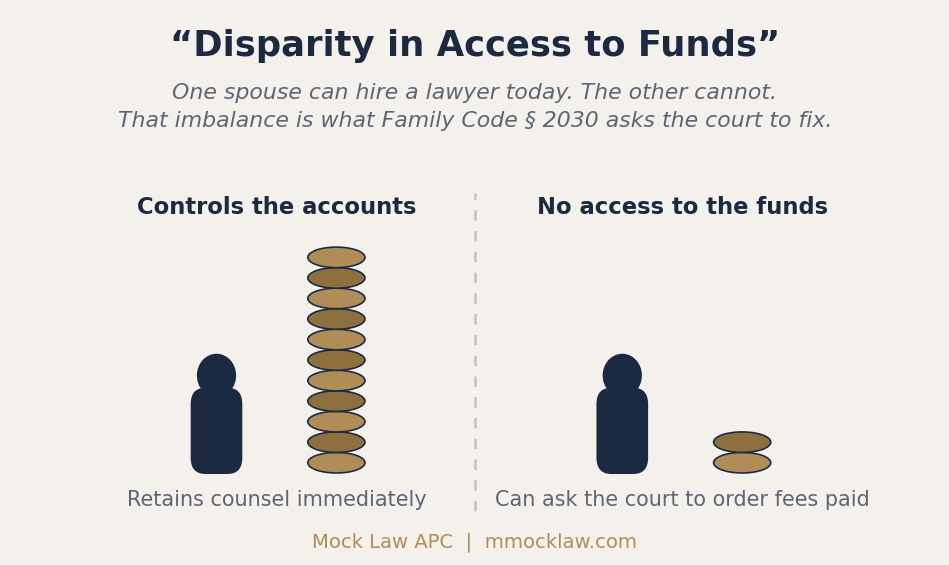
Contested divorce retainers in California commonly run $5,000 to $15,000, with hourly rates typically landing between $400 and $700. For a spouse who has been out of the workforce, or who does not control the household accounts, that is not a number you produce on short notice. Meanwhile, the higher-earning spouse writes a check and walks into court with counsel.
That imbalance is exactly the gap section 2030 was written to close.
What Family Code Section 2030 Actually Requires
Most people assume a fee award is something you get at the end, as reimbursement. Section 2030 goes further than that. Here is what the statute directs:
- The court “shall ensure that each party has access to legal representation,” including access early in the proceedings — not just at the end.
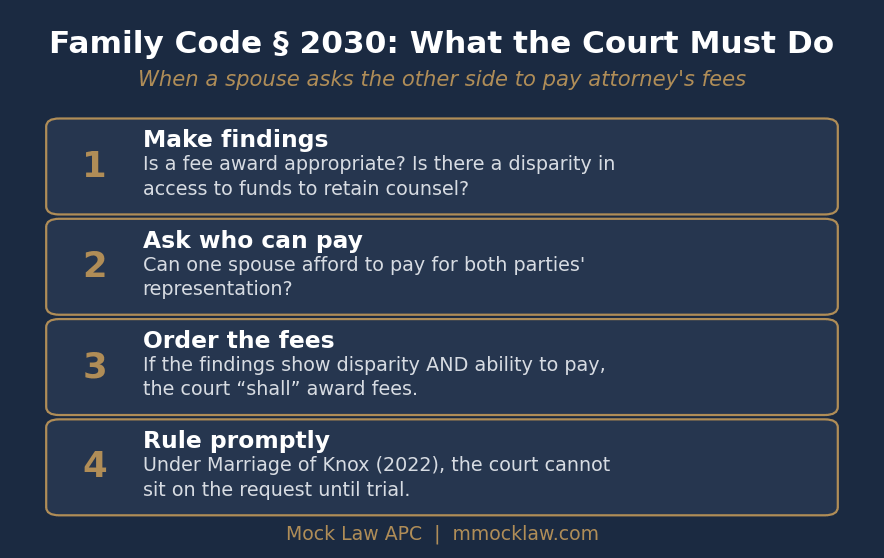
- When a fee request is made, the court must make findings on (1) whether a fee award is appropriate, (2) whether there is a disparity in access to funds to retain counsel, and (3) whether one party is able to pay for legal representation of both parties.
- If those findings show disparity in access AND ability to pay, the court “shall make an order awarding attorney’s fees and costs.” The word is shall, not may.
- The statute expressly allows a self-represented spouse to ask the court to order the other spouse to pay “a reasonable amount to allow the unrepresented party to retain an attorney in a timely manner before proceedings in the matter go forward.”
Read that last bullet again. You do not have to already have a lawyer to ask for fees to hire one. You can ask in pro per — on your own — and the request is meant to be decided before the case moves forward without you.
Marriage of Knox: The Court Cannot Sit on Your Request
In 2022, the Court of Appeal made this concrete. In In re Marriage of Knox (2022) 83 Cal.App.5th 15, the wife filed a request that included attorney’s fees in May 2018. The family court never ruled on it. Her attorney later withdrew, and she went through a three-day trial in 2019 representing herself, against a represented spouse, with her fee request still undecided.
The Court of Appeal reversed. Its holding, in plain terms:
- Section 2030 requires the family court to hear and rule on a pendente lite (during-the-case) fee request with “reasonable promptness.”
- Family courts “must not unreasonably delay their ruling” on such a request
- Deferring the fee request to trial does not satisfy the statute — the whole point is access to counsel while the case is being litigated.
- The failure to rule was prejudicial, because a prompt ruling — even a denial — would have told her where she stood in time to make different choices.
The practical lesson: a fee request that sits on a shelf is not a fee request that has been decided, and “we’ll take it up at trial” is not an answer the statute permits.
What a Fee Request Is Not
Keep in mind what a fee request is not:
- It is not a blank check. The court awards what is reasonably necessary, and it weighs both parties’ relative circumstances — income, assets, debts, and need.
- It is not automatic. You must actually file the request, with a current Income and Expense Declaration and the required supporting declarations. A judge cannot make findings on financial information nobody gave them.
- It is not only for the start of the case. Fees can be awarded for services rendered before or after the case began, and the court can augment or modify an award as the case goes on — including after an appeal.
- It is not limited to pre-trial litigation. The same access-to-counsel principle runs through post-judgment proceedings on custody, support, and enforcement.
If the Retainer Is the Only Thing Stopping You
Then the retainer may be the first issue your attorney litigates rather than the reason you never call one. In many of these cases, the fee request is the first document filed — and it is filed on the theory the Legislature wrote into the statute: the spouse who controls the money does not get to win by outspending the other one.
Bring what you have — pay stubs, tax returns, bank statements, whatever you can access — and let us tell you honestly whether a section 2030 request fits your facts. The answer to “I can’t afford a lawyer” is frequently a first conversation, not a closed door.
Disclaimer: This post is general information about California law, not legal advice, and does not create an attorney-client relationship. Outcomes depend on the specific facts of your case.