
When parents separate, children carry a weight they did not ask for. Most kids do not announce that they are struggling. They show it — a slipping grade, a stomachache every Sunday night, a teenager who suddenly has nothing to say. Parents often tell us the same thing: I know my child needs help. I just don’t know where to start.
This page is a starting point. Below are the mental health, school, court, and crisis resources available to California children whose parents are divorcing, fighting over custody, or locked in ongoing conflict. Most cost little or nothing.
If your child is in immediate danger, call 911. If your child is talking about suicide, self-harm, or is in emotional crisis, call or text 988 (Suicide & Crisis Lifeline) — free, confidential, 24 hours a day.
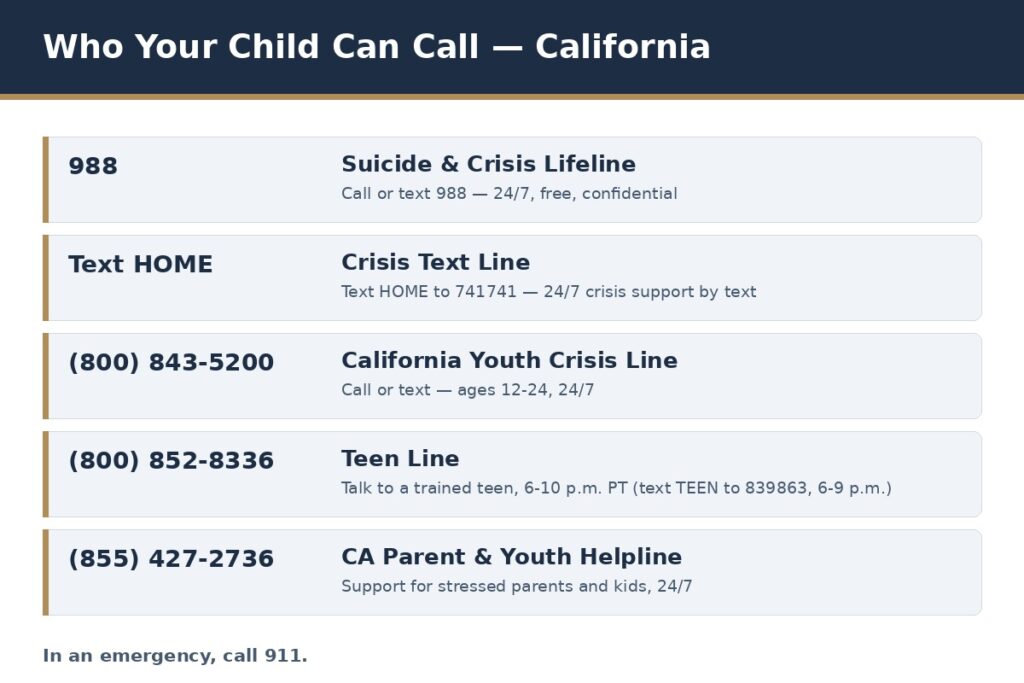
Free, confidential lines your child — or you — can call or text.
How Divorce and Conflict Affect Kids
Divorce itself is not what harms most children. Research and decades of family court experience point to the same culprit: conflict between the parents, especially conflict a child sees, hears, or is pulled into. Watch for:
Younger children: clinginess, regression (bedwetting, baby talk), sleep trouble, stomachaches and headaches with no medical cause
School-age children: falling grades, trouble concentrating, refusing to go to school, blaming themselves for the split
Teens: withdrawal, anger, risky behavior, substance use, taking on a parent’s emotional burdens
Any age: a child who feels they must choose sides, carry messages, or keep secrets between two homes
If your child is in immediate danger, call 911. If your child is talking about suicide, self-harm, or is in emotional crisis, call or text 988 (Suicide & Crisis Lifeline) — free, confidential, 24 hours a day.
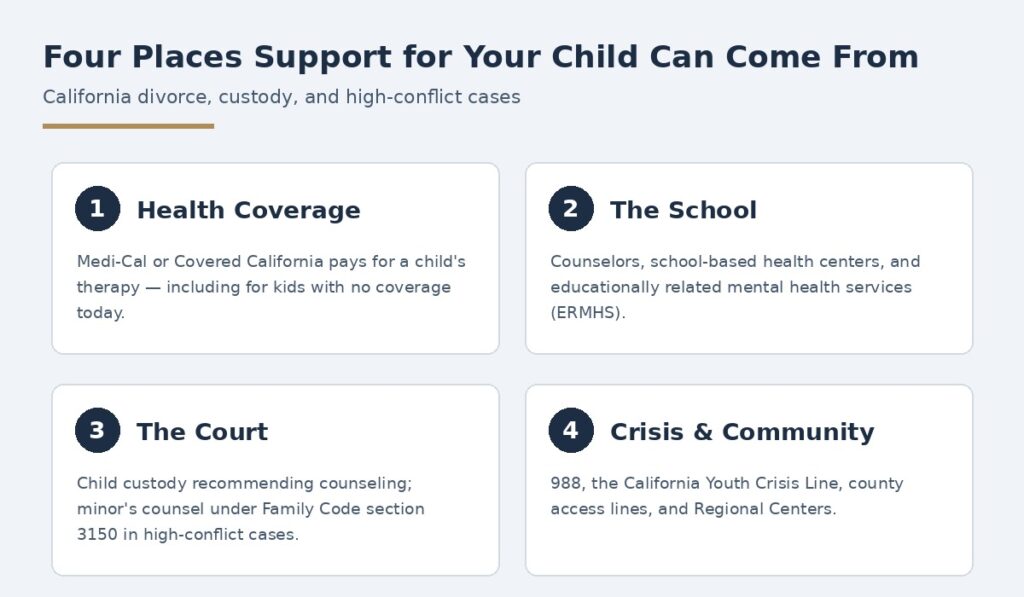
Support for your child can come from four directions at once.
1. Getting Counseling Paid For
If your child has no health insurance
Medi-Cal: California’s free or low-cost coverage, and it covers children’s mental health care. Apply for Medi-Cal — you can apply any time of year.
Covered California: individual and family plans, often with subsidies. Apply through Covered California.
Through a job: ask your employer about group coverage. A divorce or legal separation is typically a qualifying life event that opens a special enrollment window — ask about deadlines right away.
More on comparing individual and family plans: California Department of Insurance.
If your child has insurance but you don’t know where to begin
Call your county’s Medi-Cal mental health access line — multilingual, and every county has one. Find your county’s number.
Ask your child’s pediatrician for a referral to a therapist or counselor. This is often the fastest route.
Call the member services number on the back of your insurance card and ask for help finding a mental health provider for a child.
Medi-Cal Mental Health Ombudsman: (800) 896-4042, Monday–Friday, 8 a.m.–5 p.m. They help you navigate the system when you are stuck.
If your child has a developmental disability, contact your local Regional Center for connections to services.
If you are hitting walls
Call your health plan’s member services line first. If the problem isn’t fixed, you can file a complaint or request an Independent Medical Review.
Health Consumer Alliance: free help for Californians fighting their health plan. Call (888) 804-3536 or visit healthconsumer.org.
2. What the School Can Do
Schools are the most underused resource in a custody case. They are also free and already in your child’s life five days a week.
Tell the school what is happening. A counselor, teacher, or administrator who knows there is a separation at home can watch for warning signs and connect your child to on-campus support.
School counselors and social workers can often meet with a child quickly — no insurance, no waitlist.
School-based health centers (SBHCs) provide physical and mental health care right on campus. Check whether your county has one.
Educationally related mental health services (ERMHS): if your child’s emotional struggles are interfering with learning, you can request a special education assessment in writing and specifically ask about ERMHS. Put the request in writing and date it — that starts the district’s legal clock.
Give the school a copy of your custody order so both parents’ rights to records and pickup are clear, and the school is never put in the middle.
3. What the Family Court Can Do
Child custody mediation / child custody recommending counseling. Before a judge decides custody, California law sends parents to a court counselor — a trained mental health professional — to try to build a parenting plan. Depending on your county, that counselor may also write a recommendation to the judge. What to expect from family court mediation.
Minor’s counsel. Under California Family Code section 3150, a judge may appoint a lawyer to represent the child’s best interests. Courts most often consider it when custody is highly contested or drawn out, when the conflict is visibly stressing the child, or when there are allegations of abuse or neglect.
Court orders for counseling. Judges can order counseling for a child, and can address which parent pays and who has authority to consent to treatment. If the other parent is blocking your child’s therapy, that is something the court can hear.
Court self-help centers. Every California superior court has one, and they are free. Start at the California Courts Self-Help Guide.
Consent matters. Whether one parent can put a child in therapy alone depends on how your custody order allocates legal custody. If you share joint legal custody, get clear on what your order requires before you schedule that first appointment — or ask the court to clarify it.
4. Crisis Lines and Immediate Support
988 Suicide & Crisis Lifeline: call or text 988 — 24/7, free, confidential, for anyone in emotional distress.
Crisis Text Line: text HOME to 741741 — 24/7 support by text, which many teens will use when they will not pick up a phone.
California Youth Crisis Line: call or text (800) 843-5200 — for youth ages 12–24 and their families, 24/7.
Teen Line: call (800) 852-8336 (6–10 p.m. PT) or text TEEN to 839863 (6–9 p.m. PT) — your teen talks to a trained teen.
California Parent & Youth Helpline: (855) 427-2736 — 24/7 support for parents who are overwhelmed, and for kids. caparentyouthhelpline.org
SAMHSA National Helpline: (800) 662-4357 — free, 24/7 treatment referrals and information.
Hotline vs. warmline. A hotline is for an immediate crisis. A warmline is for the moment before a crisis — when someone just needs to talk to a person. You do not have to wait for an emergency to call.
Practical Steps for Parents, Starting Today
Ask one open question a day and let the silence sit. “How was today, really?” beats “Are you okay?”
Keep the routine. Same bedtime, same rules, same expectations in both homes when you can manage it. Predictability is medicine.
Never make your child the messenger. Use a co-parenting app or email for exchanges with the other parent.
Let your child love the other parent out loud, without guilt. This is hard. It is also the whole job.
Get your own support. A parent who is regulated is the best resource a child has. Your therapy is not a luxury; it is part of your child’s care plan.
Write down what you observe — dates, behaviors, school reports. If custody is contested, contemporaneous notes are far more useful to a court than memory.
Your child’s wellbeing is the whole point of a custody case. We help California parents build parenting plans and court orders that protect kids from the conflict — including orders addressing counseling, consent to treatment, and minor’s counsel when a case demands it.
Contact us now to discuss your legal situation.
This page is general information for California parents and caregivers, not legal or medical advice, and does not create an attorney-client relationship. Programs, phone numbers, and eligibility rules change — confirm details with the provider before you rely on them.